
Decline of Mughal Empire - India
The Mughal Empire was once one of the strongest empires in the world. It ruled a large part of India for almost 200 years. But in the 18th century, the empire slowly became weak and finally collapsed. By 1803, even Delhi was taken over by the British, and the Mughal Emperor became only a pensioner of a foreign power.
🧠 EASY MIND MAP: Mughal Empire & Its Decline
🟦 Mughal Empire (1526–1707)
Founder: Babur
Strong rulers: Akbar, Jahangir, Shah Jahan
Features:
Strong central administration
Powerful army
Religious tolerance (especially under Akbar)
Good revenue system
🟦 Turning Point
Death of Aurangzeb (1707)
Long wars + strict policies
Resources and administration weakened
🟦 Causes of Decline
Weak successors
Wars of succession
Jagir crisis
Peasant exploitation
Corruption and factionalism
Weak army and poor leadership
Rise of regional powers
Foreign invasions (Nadir Shah, Abdali)
No feeling of nationalism
🟦 Final Stage
1761: Mughal rule limited to Delhi
1803: British captured Delhi
Mughal emperor became symbolic ruler

Background of the Decline
The main turning point came after the death of Aurangzeb in 1707. His long wars, strict rules, and heavy taxes weakened the system. Though the empire looked strong from outside, the base had already started cracking. This hidden weakness later caused the Decline of Mughal Empire – India .
War of Succession After Aurangzeb
After Aurangzeb died, his sons started fighting for the throne. This fight is called a civil war.
Soldiers were wasted
Money was spent on wars
Law and order broke down
These internal fights played a big role in the Decline of Mughal Empire – India .
Rule of Bahadur Shah I
Bahadur Shah I tried to rule with peace and tolerance.
He respected Hindu rulers
He stopped destroying temples
He tried compromise instead of force
But he failed to control big problems like Rajputs, Marathas, and Sikhs. His weak control increased the declined of mughal .
Rajput and Maratha Problems
Bahadur Shah tried to control Rajput states like Amber and Marwar but failed.
He also did not fully accept Maratha demands like chauth. Because of this:
Rajputs resisted
Marathas continued revolts
These regional problems pushed the empire further into the declined of mughal.
Sikh Revolts
The Sikhs revolted under Banda Bahadur.
They captured large areas
Mughal control weakened in Punjab
Even though Mughals later defeated them, the damage was already done. This revolt became another reason for the declined of mughal .
Weak Administration and Money Problems
The Mughal administration became careless.
Too many jagirs were given
Government income reduced
Expenses increased
Without money and discipline, the empire could not survive long. This financial weakness added to the declined of mughal .
Continuous Civil Wars
After Bahadur Shah’s death, Mughal princes kept fighting each other.
Now nobles also became very powerful and used kings like puppets.
This constant instability speeded up the declined of mughal (8).
Weak Rulers Like Jahandar Shah
Jahandar Shah was not serious about ruling.
He loved pleasure
He depended fully on his wazir
Such weak rulers could not save a big empire. His rule clearly showed the declined of mughal .
Final Stage of Decline
Slowly, Mughal power was limited only to Delhi.
In 1803, the British captured Delhi, and the Mughal emperor became only a pension holder. This marked the final declined of mughal .
Easy Memory Trick
C-W-F-W-B
Civil wars
Weak rulers
Financial problems
Wars and revolts
British entry
this article is writen by edunoq
Sources taken from :
UPSC prelims question :
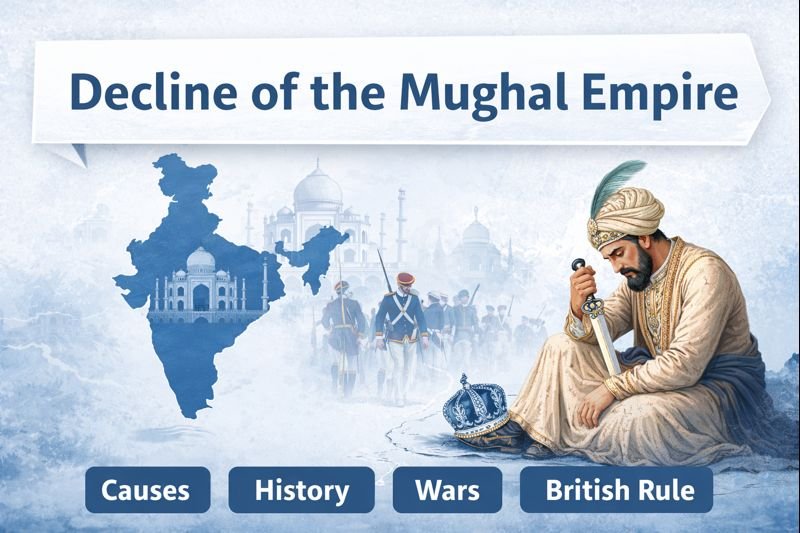
The Mughal Empire was one of the greatest empires in Indian history. It was founded by Babur in 1526. For many years, the empire was strong, rich, and well governed. Rulers like Akbar, Jahangir, and Shah Jahan made the empire powerful. However, after some time, problems started to grow, leading to the Decline of Mughal Empire – India .
Akbar followed a policy of religious tolerance and strong administration. The revenue system was fair, and the army was well organized. Because of this, the Mughal Empire remained stable for a long time. But during Aurangzeb’s rule, continuous wars in the Deccan drained money and manpower. These policies laid the foundation for the Decline of Mughal Empire – India .
After Aurangzeb’s death in 1707, the Mughal Empire faced serious problems. There was no fixed rule of succession, so Mughal princes fought among themselves for the throne. These wars weakened the army and administration. This internal conflict became a major reason for the Decline of Mughal Empire – India .
The Mughal emperors who came after Aurangzeb were weak and inefficient. They were more interested in luxury than governance. Powerful nobles controlled the kings and fought among themselves. This situation further accelerated the Decline of Mughal Empire – India .
Another important reason was the jagir crisis. The number of nobles increased, but land revenue did not. Jagirdars tried to collect maximum tax from peasants. As a result, farmers became poor and angry. Peasant revolts weakened the empire and contributed to the Decline of Mughal Empire – India .
The Mughal army also became weak. Soldiers were not paid regularly, discipline was poor, and many soldiers were mercenaries. The navy and modern technology were ignored. Because of this military weakness, the empire could not protect itself, leading to the Decline of Mughal Empire – India .
At the same time, many regional powers became strong. Bengal, Awadh, Hyderabad, and the Marathas acted independently. They stopped obeying the Mughal emperor. The rise of these regional states was another step in the Decline of Mughal Empire – India .
Foreign invasions gave a severe blow to the empire. In 1739, Nadir Shah invaded India and looted Delhi. He took away huge wealth and destroyed Mughal prestige. Later, Ahmad Shah Abdali invaded many times. These invasions clearly exposed the Decline of Mughal Empire – India .
There was also no sense of nationalism among the people. People were loyal to their caste, region, or local rulers, not to the empire. This lack of unity made it difficult to resist enemies and speeded up the Decline of Mughal Empire – India .
By 1761, after the Third Battle of Panipat, the Mughal Empire was reduced to Delhi alone. The emperor had no real power. This situation marked the final phase of the Decline of Mughal Empire – India .
In 1803, the British captured Delhi. The Mughal emperor became a pensioner of the East India Company. Though the Mughal dynasty continued till 1857, it had no authority. This completed the Decline of Mughal Empire – India .
In conclusion, the Mughal Empire declined due to weak rulers, internal conflicts, economic problems, military failure, regional independence, and foreign invasions. All these factors together explain the historical process known as the Decline of Mughal Empire – India .


